 WhatsApp: +86 16626708626
 Email:
  Phone: +86 16626708626
Description
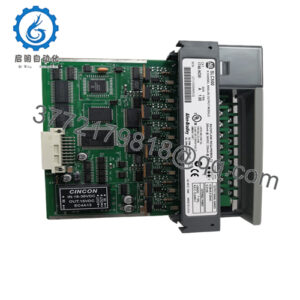
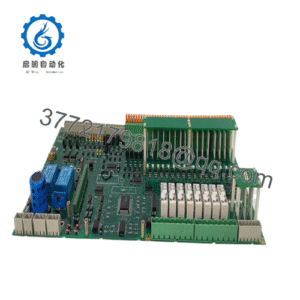
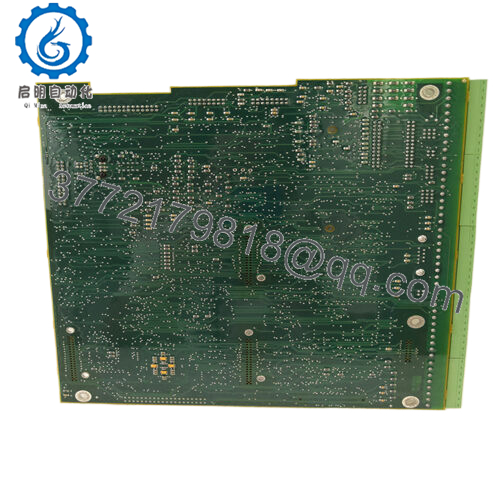
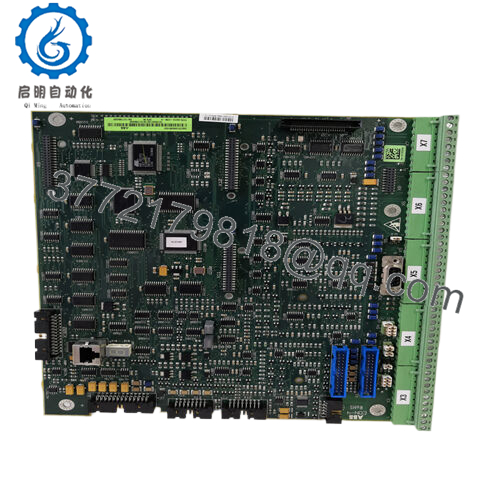
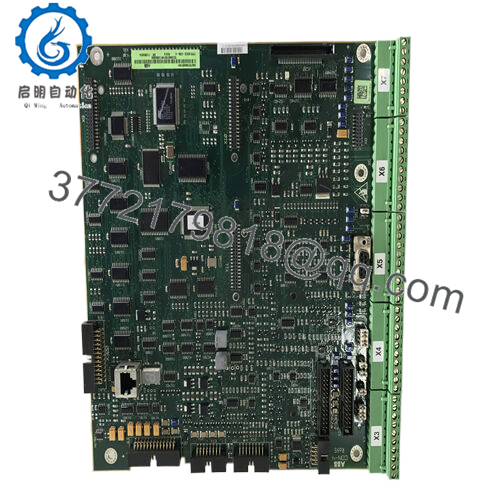
Product Model: SDCS-CON-4
Product Brand: ABB
Product Series: DCS800 (Control Board / Electronic Tray)
Product Features:
- OEM main control board for DCS800 converter modules, handles logic, interface and I/O.
- Coated (COAT-ROHS) version available for enhanced environmental resilience.
- Supports multiple supply rails (48 V, 24 V, ±15 V, 5 V CPU etc) and critical watchdog/fault monitoring.
- Designed for rapid replacement in industrial drive cabinets, minimizing downtime.
Applications & Industry Context
In large-scale industrial environments where heavy DC drives remain in service — such as in mining mills, metallurgical plants, marine propulsion, and legacy renewable energy conversion systems — control reliability is paramount. The SDCS-CON-4 board from ABB plays a pivotal role within the electronic tray of the drive converter module (sizes D1 through D4 in the DCS800 family).
Operators often face harsh ambient conditions: elevated temperatures, vibration, dust, humidity and corrosive atmospheres. A failure of the main control board can lead to major downtime, production loss, or cascading faults across the drive system. That’s where a robust module such as SDCS-CON-4 steps in.
For example, in a steel-rolling mill equipped with a DCS800 drive stack, the SDCS-CON-4 monitors thyristor firing, analog and digital I/O signals, communication buses and internal status displays. A worn-out unit or one subjected to repeated surges might start showing erratic behavior — mis-firing, logic resets, or drive faults. Replacing it with a fresh SDCS-CON-4 restores stable operation.
In retrofit projects, where older DCS drives are being served, stock of SDCS-CON-4 modules is a wise investment. Engineers keep spares on the shelf so that when a drive trips unexpectedly, the replacement board can arrive and be installed quickly. Because it plugs directly into the same tray footprint and uses the same connectors, downtime is kept minimal.
Additionally, in environments like offshore or chemical plants where electronics may be exposed to salt-air or harsh humidity, the COAT-ROHS version of SDCS-CON-4 provides added protection, reducing risks of corrosion on board traces or connectors.
Thus across industry contexts—from heavy manufacturing to power conversion—the SDCS-CON-4 fills a critical gap: ensuring the logic and interface layer of a drive remains reliable, maintainable, and ready for rapid recovery.
Product Role & System Fit
The SDCS-CON-4 module is the brain of the converter’s electronic tray. While other modules manage power conversion (rectifier, DC bus, inverter/thyristor, PIN interfaces) and auxiliary supplies (POW modules), the SDCS-CON-4 integrates control, monitoring, communication, and user-interface functions. According to ABB’s hardware manual, SDCS-CON-4 is mounted in the electronic tray of sizes D1-D4 in the DCS800 line.
This board accepts multiple supply rails (48 V, 24 V, ±15 V, 5 V for CPU, etc) and monitors supply health (for example via power-fail signals from the supply board), watchdog timers, system status displays, and I/O mapping.
In the system architecture, SDCS-CON-4 interfaces upstream with the operator panel, system bus (e.g. DRIVEBUS or other protocol), and downstream with analog/digital I/O cards, thyristor firing interface cards (PIN-series), auxiliary power boards (POW-series), and other modules. It is physically designed to mount exactly where earlier versions (CON-1, CON-2, etc) sat, making it a direct mechanical and electrical fit in many retrofits.
From a maintenance engineering standpoint, when you’re planning spares strategy for a DCS800 drive, the SDCS-CON-4 is a core board to stock—since a failure here tends to shut down the logic layer of the converter, which in turn stops the overall drive module. Having a known-good board ready can significantly reduce mean-time-to-repair.
In short, the SDCS-CON-4 acts as the central nerve centre of the converter’s electronics: ensuring that control logic, fault handling, communication, data storage (firmware/parameters) and interfacing with the world all operate reliably.
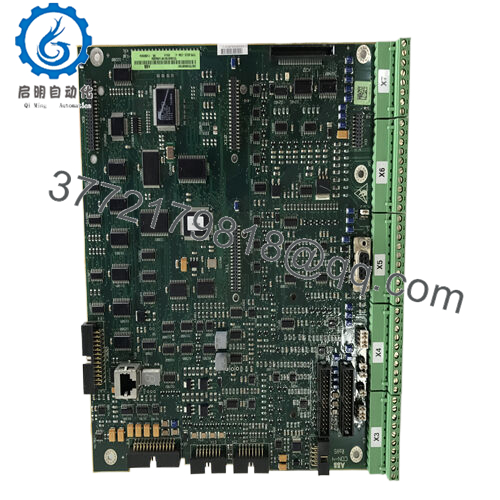
- SDCS-CON-4
Technical Features & Benefits
Here are some of the standout technical features of the SDCS-CON-4, and how they translate into benefits on the plant floor.
Multi-rail Power Supply & Monitoring
The board supports a variety of supply voltages: 48 V, 24 V, ±15 V, 5 V for CPU/encoder etc. This flexibility allows it to integrate into diverse drive architectures. More importantly, it includes monitoring for critical rails: the CPU’s 5 V rail, and a “power-fail” signal derived from the auxiliary supply board (POW/PIN modules). If the CPU sees under-voltage or power-fail, it can initiate a controlled shutdown or fault.
Benefit: Improved reliability—uncontrolled logic resets or “glitches” in control logic are reduced, leading to fewer drive trips or unexplained faults.
Watchdog & Firmware Storage
SDCS-CON-4 contains internal watchdog logic to ensure the main control program is running correctly, and stores firmware/parameters (FlashPROM). This means that even after power-cycling or a module swap, the logic board retains state and can resume rapidly.
Benefit: Faster recovery after maintenance or fault—parameters remain intact and logic board does not require full re-programming.
Coated / Harsh-Environment Version Available
The COAT/ROHS version (sometimes styled SDCS-CON-4-COAT) features protective board coating (conformal coating) tailored for environments with dust, humidity or chemical vapours.
Benefit: Enhanced uptime in tough conditions; reduced risk of corrosion, surface tracking and board failure due to contamination.
Field-Proven OEM Design
As an ABB original module (or equivalent OEM spec), the board integrates seamlessly into DCS800 converter modules without needing mechanical adaptation. Verified in many installations, it reduces integration risk.
Benefit: Lower maintenance risk, known reliability, easier commissioning.
Mechanical & Connective Compatibility
The hardware manual for DCS800 shows that SDCS-CON-4 uses the same tray, hinge, mounting, and connector layout as previous control boards in D1-D4 sized modules.
Benefit: Simplifies spares logistics and upgrade planning—one module fits multiple sizes or builds.
Diagnostics & Interface
While detailed interface specs may require the full manual, the board supports digital and analog I/O, status displays, and likely communication to higher-level supervision systems.
Benefit: Better operator visibility, improved troubleshooting capability, and easier system integration.
In practice, when a facility replaced a marginal SDCS-CON-4 board, the drive’s frequent spurious fault alarms stopped. The logic board’s improved monitoring of auxiliary rails and its better fault detection prevented intermittent resets and allowed the drive to run reliably through multiple shifts without interruption.
Technical Specifications Table
| Specification | Detail / Value |
|---|---|
| Model Designation | SDCS-CON-4 |
| ABB Ordering / Type | 3ADT313900R1501 (and revision variants) |
| Module Type | Main Control Board for ABB DCS800 Converter Modules |
| Intended Sizes | D1–D4 (in DCS800 line) – electronic tray size fits D1 to D4 modules. |
| Supply Voltages Supported | 48 V, 24 V, ±15 V, 5 V CPU/Encoder rails |
| Weight (Net) | ~0.4 kg (shipping weight around 1.5 kg) |
| Environmental Protection | Standard version and COAT-ROHS (conformal coated) version for harsh environments |
| Mounting / Tray | Electronic tray mounting in converter cabinet, same footprint as prior control modules |
| Warranty (Typical) | 12 months from many distributors |
| Catalog / Hardware Manual Reference | DCS800 Hardware Manual – “Electronic boards PIN-4 and CON-4” section |
Related Models
Here are other relevant modules worth knowing when planning spares or upgrades:
- SDCS-CON-1 – earlier version of the control board.
- SDCS-CON-2 – intermediate revision with some function changes.
- SDCS-PIN-4 – interface/pulse transformer board for firing thyristors, works in same tray.
- SDCS-POW-1 – auxiliary power supply board used to feed logic boards including SDCS-CON-4.
- SDCS-CON-4-COAT – the conformal coated version of the SDCS-CON-4 for harsh environments.
- SDCS-CON-5/CON-6 – later generation control boards for higher sizes or newer modules.
Installation & Maintenance Insights
From field experience, installing or servicing the SDCS-CON-4 is fairly straightforward but benefits from some best-practice steps:
- Pre-installation inspection: Check the board’s connectors, mounting rails, and any visible solder joints. Even small amounts of dust or oxidation in the tray can lead to poor contact and intermittent faults.
- Power sequencing: Ensure that the auxiliary power supply (POW board) is healthy and stable before the SDCS-CON-4 is activated. The board monitors power-fail signals, so unstable rails can lead to logic resets or mis-behaviour.
- Connector alignment: When inserting the board into the tray, ensure proper alignment, full insertion of edge connectors or connector plugs, and secure mounting without twisting. Poor mechanical seating is a frequent cause of intermittent faults.
- Firmware/Parameter backup: Prior to replacement, extracting parameter sets or firmware versions (if possible) is advisable. Although the board retains parameters, any change in revision may require matching of firmware versions.
- Thermal and environmental management: Make sure the cabinet has adequate ventilation or cooling. Even though the control board is not heavy in power consumption, its reliable function depends on ambient conditions. If operating in a harsh environment (humidity, dust, chemical vapors), the COAT-ROHS version is strongly recommended.
- Spare-board strategy: Maintain a spare SDCS-CON-4 (or coated version) ready for hot-swap. Since the board fits the same tray and connectors, replacement can often be done during planned maintenance or even during an unplanned trip rescue.
- Logging & trend tracking: Upon replacement, note the date, board serial/revision, operating hours and any previous fault history. By tracking failures you can detect patterns (for example, if control boards are failing prematurely, it may indicate upstream power issues or environment problems).