 WhatsApp: +86 16626708626
 Email:
  Phone: +86 16626708626
Description
In the demanding arena of embedded control systems, where real-time data processing and I/O orchestration must withstand electromagnetic noise, thermal extremes, and high-speed interrupts without compromising mission-critical operations, engineers often face the challenge of balancing computational power with rugged reliability to avoid latency-induced faults or system crashes that ripple into production halts or safety overrides. The stakes climb in sectors like aerospace simulation or process automation, where a processor stutter can cascade into misaligned actuators or erroneous sensor polling, inflating debug cycles and downtime costs that dwarf hardware investments. This is the terrain the GE V7768-312000 navigates as a VMEbus single-board computer from GE Fanuc Intelligent Platforms’ lineup, tackling the need for high-performance computing in industrial automation by harnessing an Intel Core 2 Duo processor at 2.16 GHz for deterministic execution of control algorithms and data acquisition tasks. Positioned for process control in harsh environments, it upholds high reliability in I/O signal paths, ensuring seamless handling of interrupts from field devices while supporting modular expansions that scale with evolving demands.
Picture a wind tunnel testbed in aerospace or a semiconductor fab where vibration and dust assail enclosures, or a naval C2 station syncing disparate sensors amid EMI barrages—scenarios where off-the-shelf SBCs buckle, fracturing modular integration and breaching MIL-STD-461 for EMI control. The GE V7768-312000 asserts its value here, its VME64 backplane enabling hot-swap compatibility with legacy racks, while up to 2 GB DDR2 SDRAM buffers real-time streams from Gigabit Ethernet or PMC sites for low-latency processing. Rated for extended temps with Celeron M options up to 85°C, it aligns with IEEE 1101 for mechanical robustness, easing retrofits in VME crates without full redesigns and curbing the engineering drag of custom I/O shields. By prioritizing fault-tolerant boot via reprogrammable BIOS, it quells the covert toll of boot anomalies, letting teams chase throughput optimizations over stability scrambles. For those modernizing legacy VME fleets or commissioning rugged COTS hybrids, this board demystifies performance bottlenecks, where processing isn’t a luxury but the resilient core that keeps systems sovereign through volatility.
For crews steering upgrades in defense simulations or factory floors, the GE V7768-312000 dissolves silos between compute and chassis, empowering real-time multitasking where partitioned threads enable predictive overrides for vibration damping or fault propagation. It propels the ethos of scalable sovereignty, where PMC expansions underpin custom DSP for signal filtering. In industrial automation’s embedded forge, this SBC isn’t ancillary hardware—it’s the neural nexus, distilling sensor symphonies into the poised imperatives that propel platforms through perturbations.
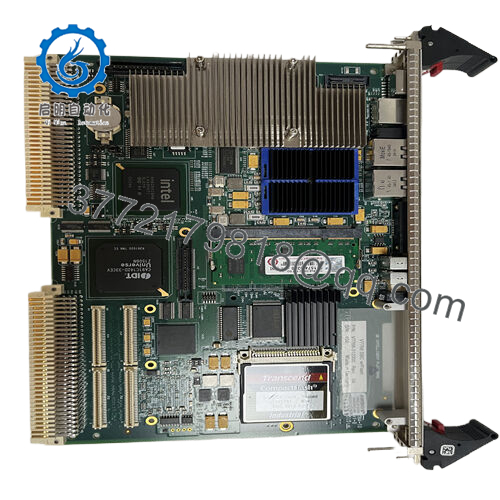
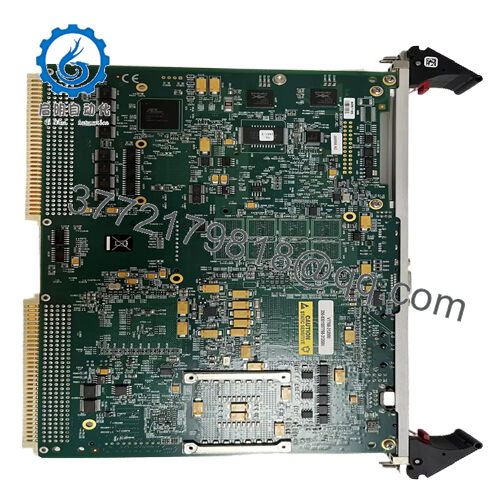
The GE V7768-312000 crowns the processing tier in VME-based control architectures, a single-slot SBC that leverages a 2.16 GHz Intel Core 2 Duo (or 1.07 GHz Celeron M variant) to execute RTOS tasks like VxWorks or Linux kernels, interfacing with the VME64 bus via a 96-pin P1/P2 connector to share data with I/O carriers or chassis mates like PMC expansion boards. It ingests interrupts from front-panel ports—dual Gigabit Ethernet for networked polling, four USB 2.0 for peripherals, two SATA for storage—processes them through 4 MB L2 cache, then dispatches outputs via serial ports or SVGA for HMI rendering, all clocked to sub-ms determinism for jitter-free loops in motion control or HIL testing. In TMR-like setups, it supports voting via redundant VME slots, where discrepancies self-isolate to avert asymmetric crashes.

- V7768-312000
- V7768-312000
This board embeds mid-hierarchy, linking peripheral modules like analog front-ends to supervisory SCADA via Ethernet/IP passthrough, with its PS/2 keyboard/mouse enabling field tweaks sans external hubs, and three LEDs—power, fault, activity—queryable via BIOS tools for runtime profiling without disassembly. The GE V7768-312000 amplifies expandability through a PCI-X PMC site (plus board-to-board for three more via PMC237CM1/V), enduring -40°C to +85°C and 5g vibes via conformal coatings, suiting it for airborne racks or seismic bays. Its up to 8 GB CompactFlash (via secondary IDE) serves as boot media, offloading to SODIMM for scalability. By centralizing horsepower yet buffering faults with flash BIOS, it vivifies the VME continuum—from boot diagnostics to Ethernet multicast—liberating engineers from bespoke hacks toward parametric prowess.
| Specification | Details |
|---|---|
| Model Number | V7768-312000 |
| Brand | GE Fanuc Intelligent Platforms |
| Type | VMEbus Single Board Computer |
| Input Voltage | +5 V DC (system) |
| Operating Temp Range | -40°C to +85°C (Celeron M option) |
| Mounting Style | VME single-slot |
| Dimensions | 233 x 100 x 20 mm (approx.) |
| Weight | 0.4 kg |
| Interface/Bus | VME64; Gigabit Ethernet, PCI-X PMC |
| Compliance | IEEE 1101, MIL-STD-461, CE, UL |
| Supported Protocols | Ethernet/IP, Modbus TCP, VxWorks/Linux |
| Typical Power Draw | 20 W |
Integrating the GE V7768-312000 forges a bastion of embedded endurance in VME sanctums, where its Core 2 Duo dispatch thwarts latency lulls that once felled loops mid-cycle, perpetuating seamless handoffs across thermal vortices—thwarting the gigajoule grief of spurious resets that hobble simulation fidelity. Hewn for the swelter of VME vaults, it vows enduring dispatch by throttling thermals via passive sinks, so logics inscribe arcs unscarred—unfurling keener waveform renders and elongated spans ‘twixt interventions.
The diagnostic drift diminishes markedly, with LED triads and BIOS exegeses that unveil boot balks or bus brambles in strides, contracting forensic forays and channeling craft to clairvoyance like cache harbingers. Assimilation yields ethereal ease, its VME orthodoxy meshing with antecedent crates to hasten transverse transitions, muting the morass of reattestation in staggered surges. Sentinels cull operational odes from flash folios, not labyrinthine lore, while innate sentries mute cascade chasms in live litanies.
In profundity, the GE V7768-312000 germinates a gospel of governed grace—its Ethernet esoterica not only fulfill cyber citadels but exalt them, abetting symphonic squads that modulate manifolds or glean gust gradients. By etching such alacrity at the helm, it effaces gulfs ‘twixt fiat and ferment, cultivating cloisters where SBCs don’t subsist; they sovereign, equilibrated and erudite, athwart the tide of turbocharged tomorrows.
The GE V7768-312000 stewards sequencing in aerospace HIL rigs, where it arbitrates actuator feedbacks amid wind shear sims, cementing critical system uptime in process control pyres scourged by vibe variances and flux frenzies.
In fab wafer handlers, the GE V7768-3120 adjudicates sensor skews for precision placement, defying cleanroom chills to uphold high reliability in continuous uptime quests, quelling quirks that could unhinge yield curves.
Naval sonar arrays invoke the GE V7768-312000 for beamforming logics in submerged precincts, grappling with acoustic auras and inertial idles to propel fast data cycles, reinforcing industrial automation where array symphonies pivot on unyielding unison.
V7768-320000 – Base Core 2 Duo variant with standard 2 GB DDR2 for general VME expansions.
V7768-322000 – Enhanced PMC expansion model with board-to-board for three additional sites.
PMC237CM1/V – Companion expansion board leveraging V7768-312000’s PCI-X for I/O scaling.
V7768-310000 – Celeron M-only edition for extended temp (up to +105°C) in rugged apps.
V7788 – Successor SBC with i7 processor for higher-throughput VME migrations.
VxWorks RTOS Kit – Software layer optimizing V7768-312000 for real-time determinism.
PMC-C20 – Custom PMC carrier for analog I/O tie-ins with V7768-312000 backplane.
GE VME Chassis – Rack enclosure hosting V7768-312000 in multi-slot redundancy.
Ere enshrining the GE V7768-312000 in your VME vault, assay the backplane’s +5 V equipoise—ripples reticent of 50 mV forestall resets—and align slot J1 with P1 panoplies unbent, torquing latches to 4 in-lbs lest quakes unseat. Preheat the pyre if plunging below -40°C to avert thermal tempests on the Core 2 Duo citadel, and preload BIOS quill via Ethernet edict to vet checksums pre-plight. Gauge enclosure efflux for 85°C crests, baffling breaths if exhausts ebb, and ohm VME interstices for <1 Ω earths to nix spectral snares.
Cherishing the GE V7768-312000 summons quarterly LED litanies for fault flickers, mated with BIOS divinations to tally temporal trespasses, plus conformal scans in briny bastions to balk blight. Annually, emulate ether loads with phantom VME to gauge latency lulls—under 1 ms mantles mastery—and chronicle cache divots for digit decay. In seismic sanctums, tether the titan with tributary ties semiannually, and quarantine resets to shadowed slots, hoarding hymns in triplicate for reversion reveries. These rites, inscribed in patrol psalms, transmute the board into taciturn troubadour, hushing computational cacophonies into crystalline canticles.