 WhatsApp: +86 16626708626
 Email:
  Phone: +86 16626708626
Description
Technical Specifications Table
| Specification | Detail |
|---|---|
| Model | GE V7768 |
| Brand | GE / GE Fanuc |
| Series / Family | VME Embedded Computing / Intelligent Platforms |
| Processor Options | Intel Core 2 Duo (up to ~2.16 GHz) or Celeron M variant |
| Memory | Up to 2 GB DDR2 SDRAM via SODIMM |
| Storage | CompactFlash (bootable), SATA interfaces |
| Ethernet | Dual Gigabit Ethernet RJ45 ports |
| USB | 4 × USB 2.0 ports |
| Serial Ports | 2 × 16550-compatible (one via front, one via P2) |
| Graphics & Keyboard / Mouse | VGA + PS/2 (front panel) |
| VME Interface | VME64, Universe II controller supporting A32/A24, D32, etc. |
| PMC Expansion | 1 PMC-X slot + board-to-board connector supporting up to 3 extra PMC sites |
| Operating Temperature | 0°C to 55°C (Core 2 Duo mode), higher for Celeron option |
| Storage Temperature | −40°C to +80°C |
| Power Requirements | +5V DC, +12V DC, −12V DC rails (low current for ±12) |
| Cooling | Forced-air cooling for high performance variants |
| Mechanical | 6U VME card, 4HP width, standard depth |
| Certifications / Compliance | Industrial / embedded class |
Product Model: GE V7768
Product Brand: GE / GE Fanuc
Product Series: VME Embedded Computing / Intelligent Platforms
Product Features:
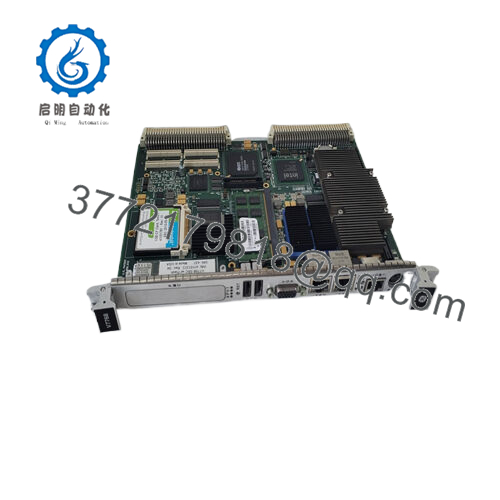
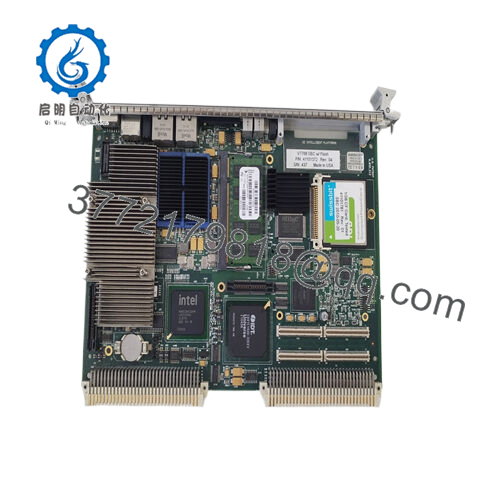
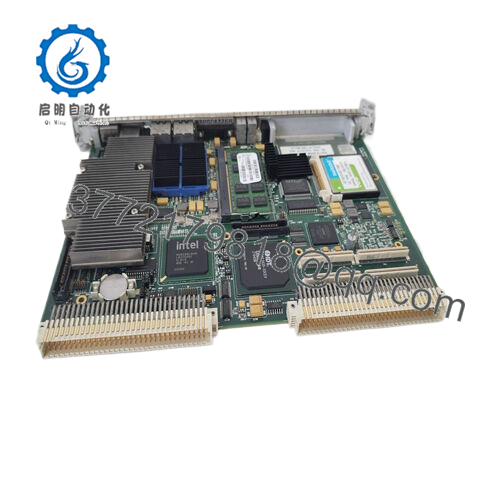
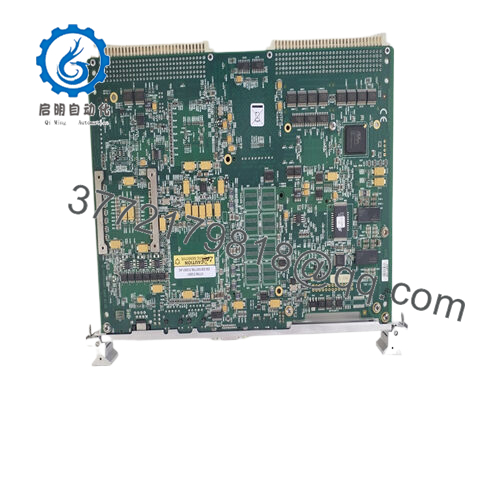
- Dual-slot VME single board computer with Intel Core 2 Duo / Celeron options
- Rich I/O: dual Gigabit Ethernet, USB, SATA, serial ports
- PMC expansion capability via board-to-board connector for additional I/O
- Rugged design for industrial deployment, supports multiple OS environments

- V7768
- V7768
Product Role & System Fit
The GE V7768 is a VMEbus single board computer (SBC) designed for demanding embedded and industrial automation environments. It serves as the computational core within VME racks, executing control logic, data acquisition, and communications in applications like factory automation, power systems, and process control.
Engineers often deploy it in VME chassis alongside I/O boards, communication cards, and signal conditioners. The V7768 supports both legacy VME backplanes and newer architectures through hybrid I/O, letting it act as a bridge between older modules and modern networked systems. With its PMC expansion support, it can scale its interface capabilities without needing a full board replacement.
It integrates smoothly into systems where real-time processing, determinism, and high-availability are critical. In many plants, it replaces older SBCs while preserving much of the field wiring and I/O infrastructure, reducing retrofit risk.
Technical Features & Benefits
The GE V7768 offers a compelling blend of performance, flexibility, and industrial robustness. Based on the publicly available datasheet:
- It supports an Intel Core 2 Duo CPU (up to ~2.16 GHz) or a Celeron M variant for lower power applications.
- Memory support includes up to 2 GB DDR2 SDRAM via a single SODIMM slot.
- It includes dual Gigabit Ethernet ports on the front panel, supporting high-speed data exchange and networked operations.
- I/O features: two serial ports (16550-compatible), four USB 2.0 ports, two SATA interfaces, VGA output, and keyboard/mouse PS/2 interface.
- VMEbus interface is supported via a Tundra Universe II controller, with support for standard VME64 modes (A32/A24, D32, etc.).
- PMC expansion is possible via a board-to-board connector (especially when paired with a PMC237 expansion board), giving additional sites for I/O flexibility.
- The board is designed to operate in industrial and extended-temperature environments, with appropriate cooling (forced-air or heatsinks) depending on CPU variant.
These features make the V7768 suitable for embedded control, data processing, protocol conversions, and bridging tasks, all within a proven embedded computing footprint.