 WhatsApp: +86 16626708626
 Email:
  Phone: +86 16626708626
Description
| Specification | Details |
|---|---|
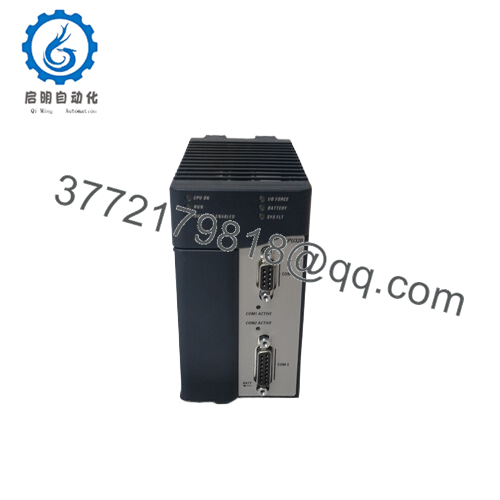
| Model Number | IC695CPE302 |
| Brand | GE (Emerson) |
| Type | RX3i CPU with Ethernet |
| Input Voltage | 5 V DC / 3.3 V DC (backplane) |
| Operating Temp Range | 0 to 60 °C |
| Mounting Style | RX3i Universal Backplane Slot |
| Dimensions | 5.57 x 1.57 x 5.12 in (141.5 x 40 x 130 mm) |
| Weight | 0.75 lb (0.34 kg) |
| Interface/Bus | PCI Express, Dual Gigabit Ethernet |
| Compliance | CE, cULus, ATEX Zone 2, RoHS |
| Supported Protocols | PROFINET, OPC UA, MQTT, Modbus TCP |
| Typical Power Draw | 1.2 A @ 5 V, 0.5 A @ 3.3 V |
Choosing the GE IC695CPE302 injects a measurable leap in system responsiveness and future-proofing that compounds across your operation. Its dual-core design ensures high reliability under concurrent loads—run 10,000 rungs of logic at 0.3 ms while streaming 500 tags via OPC UA, and you still hold 30% headroom for unplanned additions like new safety routines. This headroom translates to tighter process control: faster scan times shrink deadband in cascade loops, yielding energy savings in HVAC or smoother trajectories in robotics.
Maintenance efficiency rises sharply too—embedded web diagnostics let technicians view CPU vitals from any browser, spotting memory leaks or Ethernet collisions before they escalate, often halving root-cause analysis time. Integration overhead evaporates: drop-in replacement for CPE305/310 models means reusing existing I/O and wiring, with Proficy auto-converting legacy projects. Long-term, its fanless, convection-cooled enclosure shrugs off dust and vibration, ensuring consistent performance through decade-long campaigns and reducing thermal-related drifts that plague lesser units.
What you ultimately gain is agility: the bandwidth to layer AI models locally for anomaly detection, or to synchronize with MES for lot tracing, all without external gateways. It’s engineered to keep your industrial automation ecosystem lean yet powerful, turning capital into capability.
Pharmaceutical compounding skids deploy the GE IC695CPE302 for critical system uptime in orchestrating peristaltic pumps and load cells under 21 CFR Part 11, leveraging OPC UA security for audit trails while maintaining sub-50 ms cycles in process control environments. Wind turbine nacelles rely on it to synchronize pitch and yaw across PROFINET IRT rings in -40°C gusts, where dual Ethernet redundancy guards against cable shear.

- IC695CPE302
- IC695CPE302
High-speed bottling lines integrate it with vision and servo modules in a single rack, handling 1,200 bpm with embedded web HMIs for line-side adjustments—proof of its prowess in fast data cycles and harsh, washdown-rated cabinets.
IC695CPE305 – Single-core variant for lighter logic loads
IC695CPE310 – 5 MB memory version for cost-sensitive apps
IC695CPE400 – Quad-core, 64 MB for machine learning at the edge
IC695RMX128 – Redundancy memory module for hot-sync pairs
IC695PNC001 – PROFINET controller companion for distributed I/O
IC695ETM001 – Ethernet transceiver for legacy integration
IC695ACC600 – CPU battery backup kit for power-loss retention
IC695CHS012 – Matching 12-slot backplane for dense layouts
Before racking the GE IC695CPE302, validate backplane firmware (v8.90+) and PSU capacity—pair with IC695PWR330 for headroom above 15 A total draw in fully loaded 12-slot setups. Reserve 2 inches of front clearance for USB/SD access and airflow; in vertical mounts, orient Ethernet ports downward to shed condensate. Pre-load firmware via SD card and bench-test redundancy sync with a dummy partner to confirm <50 ms transfer times.
Ongoing, monitor CPU load monthly through Proficy’s performance dashboard—trim unused web pages if exceeding 70% sustained. Quarterly, export diagnostic logs and clear event buffers to prevent memory bloat; replace the lithium battery every three years during planned outages to retain configs. Annual thermal imaging of the rack flags hot spots from aging connectors—reseat with 5 in-lb torque. Firmware updates over Ethernet require dual-port isolation to avoid bricking; always failover to the secondary first in redundant pairs. This cadence, logged in your CMMS, sustains peak efficiency and often extends mean time to failure beyond eight years.