 WhatsApp: +86 16626708626
 Email:
  Phone: +86 16626708626
Description
In industrial automation, where even a brief controller failure can cascade into massive production losses or safety hazards, achieving true high availability is non-negotiable. You’re likely dealing with scenarios like synchronized dual-controller setups in a power generation facility, where a single CPU glitch could disrupt grid feed or trigger emergency shutdowns, or in pharmaceutical manufacturing lines demanding uninterrupted batch processing to meet stringent compliance. The GE IC695CMU310-CH addresses this head-on as a Max-ON hot-standby redundancy CPU, engineered specifically for PACSystems RX3i platforms to deliver seamless failover in critical process control environments.
This module tackles the core challenge of system stability in high-reliability industrial automation by enabling two mirrored RX3i systems to operate in tandem—one active, one on standby—with automatic switchover in just a few scan cycles if the primary falters. It’s essential in situations requiring zero-downtime transitions, such as expanding legacy PLC architectures without risking operational halts or integrating redundant logic in distributed control systems prone to network interruptions. Engineers turn to the GE IC695CMU310-CH when single-point failures aren’t an option, like in oil refineries managing volatile processes or water utilities ensuring continuous pump control amid variable loads. By prioritizing hot-standby redundancy, it minimizes engineering overhead for custom failover scripts, supports high-speed data synchronization over dedicated links, and incorporates diagnostics that flag issues before they escalate. In process control contexts, where uptime directly correlates to revenue and safety, this CPU’s role in maintaining controller integrity shines—leveraging battery-backed memory to preserve states during transfers and embedding tools for real-time health monitoring. Whether you’re retrofitting for enhanced resilience in harsh environments or building new setups with modular I/O expansion, the GE IC695CMU310-CH ensures your automation backbone delivers consistent performance, incorporating SEO essentials like hot-standby redundancy, high availability CPU, and critical system uptime for industrial automation applications.

- IC695CMU310-CH
- IC695CMU310-CH
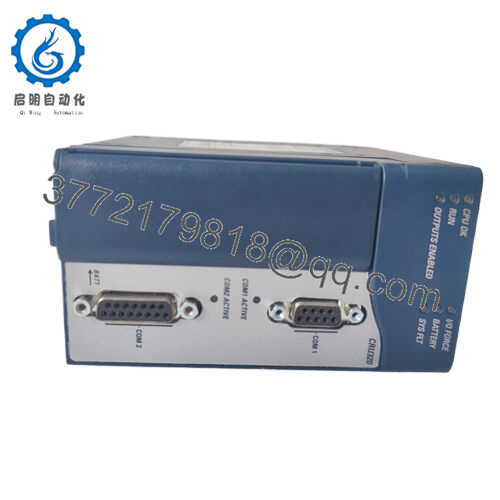
At the heart of a redundant RX3i setup, the GE IC695CMU310-CH functions as the brains of your hot-standby pair, sitting in the universal backplane and coordinating with a mirrored unit via one or two dedicated Ethernet LANs for rapid data exchange. It processes logic at 300 MHz, handling up to 10 MB of user memory while supporting protocols like Modbus RTU Slave, SNP, and Serial I/O through its two built-in ports—RS-232 and RS-485—for programmer connectivity or third-party device integration.
In the automation stack, it’s positioned as the redundancy-enabled controller layer, interfacing directly with RX3i I/O modules, Series 90-30 expansion racks, or PROFINET networks, and pairing with Ethernet interface modules for broader SCADA ties. The beauty is in its Max-ON architecture: the active CPU runs the show, syncing outputs, inputs, and registers to the standby in real time, with bumpless transfer on failure—no manual intervention needed. Diagnostics come built-in, with LEDs indicating sync status, faults, or role (primary/backup), and software-accessible logs via Machine Edition for proactive tweaks. It fits modularly into PCI-compliant backplanes, supporting hot insertion in non-redundant modes if needed, and scales with additional racks for larger I/O counts. For protocols, it leans on embedded serial for basics but shines when layered with ETM001 modules for full Ethernet redundancy. This positioning avoids the rigidity of older GE Fanuc systems, letting you evolve from single-controller designs to full high-availability without rewriting core logic—the GE IC695CMU310-CH simply drops in, configures via familiar tools, and keeps your process control flowing uninterrupted.
| Specification | Details |
|---|---|
| Model Number | IC695CMU310-CH |
| Brand | GE (Emerson) |
| Type | Redundancy CPU Module |
| Input Voltage | 5 VDC / 3.3 VDC |
| Operating Temp Range | 0°C to 60°C |
| Mounting Style | RX3i Universal Backplane |
| Dimensions | Single slot (approx. 140 x 130 x 45 mm) |
| Weight | 0.45 kg |
| Interface/Bus | PCI 2.2, Embedded Ethernet for sync |
| Compliance | CE, UL, RoHS |
| Supported Protocols | Modbus RTU Slave, SNP, Serial I/O |
| Typical Power Draw | 5 VDC @ 1A + 3.3 VDC @ 1.25A |
Opting for the GE IC695CMU310-CH equips your system with redundancy that’s truly engineered for demanding cycles, where failover isn’t just fast—it’s imperceptible to downstream processes, preserving I/O states and preventing spikes in actuators or alarms. This translates to reliability that cuts unplanned outages by orders of magnitude, letting operations run weeks or months without intervention, even in setups with frequent network hiccups or power fluctuations.
Performance consistency comes from its synchronized memory handling, ensuring the backup is always a mirror image, so transfers maintain precise timing in logic execution—critical for motion control or PID loops that can’t tolerate drift. Maintenance efficiency is another win: with onboard diagnostics and remote access via serial ports, you spot degrading sync links or battery health early, reducing hands-on rack time and extending overall system life. The module’s design minimizes engineering overhead by leveraging standard RX3i tools for configuration—no proprietary redundancy software required beyond Max-ON setup—freeing your team to focus on process optimization rather than babysitting controllers. In harsh conditions, its robust power handling and thermal tolerances ensure long-term performance without derating, turning what could be a vulnerability into a strength that supports facility expansions or tech refreshes seamlessly.
The GE IC695CMU310-CH proves its mettle in environments where critical system uptime defines success, like power plants deploying it for turbine oversight with dual CPUs syncing over fiber links to handle load shedding without blackout risks—fast scan times keep protective relays responsive amid grid instabilities. In oil and gas platforms, it’s common in offshore rigs for process control, managing valve sequencing in explosive zones with hot-standby ensuring continuous flow even during maintenance windows.
Water treatment facilities rely on it too, integrating into SCADA-heavy setups for pump and chemical dosing control under variable demand, where redundancy counters sensor failures or cyber threats without disrupting purification cycles. Across these, the GE IC695CMU310-CH excels in harsh conditions—vibration, EMI, or temperature swings—delivering high availability in distributed I/O architectures used in power plants and process control environments demanding 99.999% uptime.
IC695CMU310-LT – Low-temperature variant for extreme cold applications down to -40°C
IC695CMU310-DR – Firmware-enhanced revision with improved flash read/write logic
IC695CPU310 – Non-redundant predecessor for standard high-performance control
IC695CPE310 – Modern Ethernet-focused alternative with built-in ports
IC695CMU310-BG – Earlier revision for legacy Max-ON compatibility
IC695RMX128 – Redundancy memory expander for larger sync data sets
IC695ETM001 – Ethernet module pair for enhanced redundancy links
Prior to installing the GE IC695CMU310-CH, confirm your RX3i backplanes are universal-type and powered down—mismatched slots can cause recognition failures on boot. Check firmware alignment between primary and backup units using Machine Edition’s compatibility report; discrepancies often lead to sync refusals. Allocate space for dedicated redundancy cables—fiber optics preferred for noise immunity—and verify battery installation, as weak retention can drop states during initial power cycles. Grounding is critical in noisy plants; tie the chassis properly to avoid EMI-induced role flips.
For ongoing maintenance, cycle through the LEDs weekly—steady green on sync means all’s well, while amber flags warrant a logic download check. Quarterly, inspect serial connectors for corrosion, especially in humid setups, and run a forced switchover test in a maintenance window to confirm transfer times stay under spec. Annually, replace the lithium battery preemptively and validate Ethernet link integrity with ping tools from the programmer. These habits keep diagnostics accurate, catch wear on sync paths early, and ensure your high-availability setup remains proactive rather than reactive.