 WhatsApp: +86 16626708626
 Email:
  Phone: +86 16626708626
Description
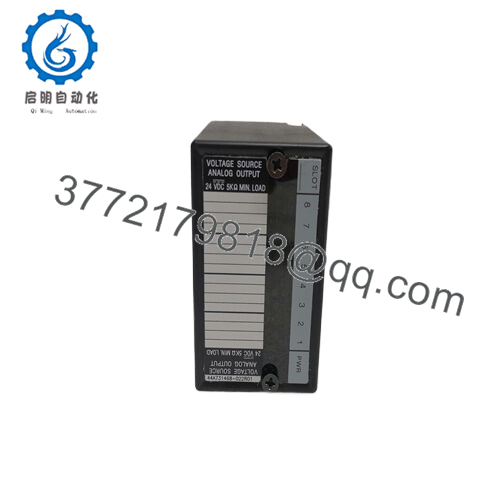
In the unforgiving arena of industrial automation, where temperature variations can spell disaster for process integrity, the battle for accurate thermal monitoring often hinges on modules that refuse to flinch under pressure. Control engineers in high-precision environments wrestle with challenges like thermocouple drift from electrical noise, junction inconsistencies across extended wiring runs, or the sheer volume of multi-point sensing in compact setups—issues that undermine I/O signal fidelity and expose systems to erroneous shutdowns or inefficient energy use. This is precisely where the GE IC670ALG630-JA delivers as a field-grade 8-channel thermocouple input module in GE’s Field Control lineup, optimized for converting raw millivolt signals into stable digital values with isolation that guards against common pitfalls in process control.
Picture a steam boiler room in a chemical plant, where erratic readings from J-type thermocouples could trigger unsafe pressure spikes, or a semiconductor fab where sub-degree accuracy is mandatory for wafer processing amid cleanroom constraints. The GE IC670ALG630-JA emerges as a cornerstone in these high-reliability scenarios, enabling distributed I/O architectures that scale without sacrificing resolution, even when integrating legacy sensors into modern DCS frameworks. It addresses the demand for modular signal handling by providing per-channel configurability, which streamlines diagnostics and reduces the custom cabling often needed for noise-prone field deployments. In the wider scope of industrial automation, this module facilitates the transition to condition-based monitoring, feeding clean temperature data into analytics tools to predict wear before it halts lines. For procurement teams sizing up alternatives, pivotal details include its support for multiple thermocouple types and its Genius bus integration—elements that dictate compatibility with existing PACs and influence total ownership costs through minimized recalibrations. By zeroing in on these thermal I/O pain points, the GE IC670ALG630-JA fortifies system resilience, transforming volatile sensor inputs into dependable assets that elevate operational precision and compliance in demanding process control landscapes.
Positioning the GE IC670ALG630-JA within your automation hierarchy feels like adding a vigilant sentinel at the sensor edge, where it meticulously captures and refines thermocouple or millivolt inputs before they ascend to the decision core. This module processes eight independent channels, each equipped with solid-state multiplexing and a 16-bit ADC that yields values in 0.1-degree increments, complete with sign for bidirectional ranges. It plugs into the Field Control rack via the Genius serial bus, interfacing with bus interface units like the IC670GBI002 to form remote drops in Series 90-70 or RX7i PAC systems, where it resides in the I/O layer as a dedicated analog front-end.
Interconnectivity is straightforward yet robust: field thermocouples wire directly to screw terminals, with optical isolation per channel shielding against ground potentials that could corrupt upstream data, while the internal microprocessor handles scaling and fault detection before bus transmission. Redundancy options via dual-bus configurations keep it viable in SIL-rated loops, and diagnostics—routed through Genius queries or front-panel LEDs—highlight open circuits or out-of-range excursions without halting the rack. Though protocol-native to Genius, it pairs effortlessly with gateways for OPC UA or Ethernet overlays, slotting into hybrid stacks where raw thermal data informs PID tunings in real time. Envision the flow: sensors in a furnace relay mV signals to the module for linearization against NIST tables, which then broadcasts calibrated °C/°F to the CPU for closed-loop adjustments, all within scan cycles under 20 ms. For deployment pros, its rack-mount form factor and jumper-selectable scaling options ease retrofits, making the GE IC670ALG630-JA a fluid enhancer of analog architectures that prioritize accuracy over complexity in thermal-heavy processes.
| Specification | Details |
|---|---|
| Model Number | IC670ALG630-JA |
| Brand | GE (Emerson) |
| Type | 8-Channel Thermocouple Input Module |
| Input Voltage | 5 V DC (internal); mV from thermocouples |
| Operating Temp Range | 0°C to 60°C |
| Mounting Style | Rack Mount |
| Dimensions | 14.2 x 2.8 x 7.5 in (36 x 7.1 x 19 cm) |
| Weight | 2.5 lbs (1.13 kg) |
| Interface/Bus | Genius Serial Bus |
| Compliance | CE, UL, CSA |
| Supported Protocols | Genius |
| Typical Power Draw | 9 W |
Incorporating the GE IC670ALG630-JA equips your operations with a level of thermal insight that turns potential vulnerabilities into strategic strengths, all rooted in its engineered precision for sustained accuracy amid flux. By linearizing inputs against standardized tables, it eliminates the interpretive guesswork that plagues unconditioned signals, allowing control algorithms to execute with fidelity that holds through thermal cycling—translating to tighter setpoints and reduced overshoot in heating profiles, where even a degree’s variance can cascade into quality lapses or energy waste.
This consistency ripples into everyday efficiencies, as channel isolation curbs cross-talk in dense sensor arrays, enabling denser rack populations without bespoke shielding investments. Maintenance teams appreciate how early fault flagging—via bus-accessible status registers—curbs escalation, often resolving to a simple lead swap rather than rack-wide scans, which streamlines schedules and preserves uptime in 24/7 regimes. Over cycles, the module’s low-drift design minimizes reference junction adjustments, fostering a regime where performance predictability lets planners forecast loads more astutely, dialing back on conservative margins that inflate costs.

- IC670ALG630-JA
- IC670ALG630-JA
At its core, selecting this module streamlines the engineering path forward: its plug-compatible footprint with Field Control ecosystems cuts integration timelines, while robust EMC handling in noisy zones lessens the need for ancillary filters, easing compliance hurdles. It’s a deliberate choice for environments where high reliability in I/O signals isn’t optional, yielding compounded returns through sharper process yields and deferred upgrades that keep capital focused on innovation.
The GE IC670ALG630-JA thrives in arenas demanding unyielding temperature oversight, like petrochemical refineries where it ingests signals from furnace thermocouples to orchestrate cracking processes under corrosive heat, ensuring critical system uptime via isolated channels that defy EMI from adjacent pumps. In metal forging operations, process control environments leverage it for monitoring billet temps across eight zones, supporting fast data cycles that synchronize hammers without thermal lag-induced defects.
Aerospace component testing rounds out its versatility, with the module racked in vibration-prone labs to track chamber profiles from K-type probes, its millivolt flexibility accommodating custom sensors for high-reliability data in continuous uptime mandates. Whether in glass manufacturing kilns or pharmaceutical autoclaves, the GE IC670ALG630-JA anchors analog I/O in harsh conditions, delivering the granular thermal mapping that upholds standards and throughput.
IC670ALG631 – Enhanced variant with RTD support for hybrid temperature sensing
IC670ALG310 – 4-channel voltage/current input for broader analog needs
IC670ALG240 – 8-channel output module pairing for closed-loop thermal control
IC670ALG330 – Current-sourcing outputs as a complementary actuator driver
IC670GBI002 – Bus interface unit for rack integration
IC670ALG320 – Multi-group analog output for scaled signal distribution
IC670MFP100 – Micro field processor for standalone edge computing
IC693ALG392 – PAC Systems analog input alternative for centralized setups
When gearing up for the GE IC670ALG630-JA, confirm rack slot availability and Genius bus addressing to sidestep config clashes—use the handheld programmer for a dry-run map that flags overlaps early. Inspect jumper settings for thermocouple type (J, K, etc.) against your sensor roster, as mismatches skew linearization; also, budget for cold-junction compensation via external references if ambient swings exceed 5°C daily. Power sequencing counts: engage the rack supply post-wiring to avoid inrush spikes, and torque terminals to 8 in-lbs for vibration resistance in field mounts. Pre-install, loop-test each channel with a precision mV source to baseline ADC response, noting any offset tweaks via software.
Ongoing vigilance keeps the GE IC670ALG630-JA performing without fanfare: bi-monthly LED audits for channel faults or bus sync, coupled with quarterly calibration runs against traceable standards to track drift under load. In dusty or humid spots, swab terminals annually to preempt corrosion, and query diagnostics during PMs to log excursions—patterns might signal cabling wear before failures mount. If a channel drops out, isolate via rack config to maintain others, then trace with a DMM for continuity. This measured cadence, leveraging the module’s self-reporting, positions it as a set-it-and-forget-it player, freeing bandwidth for evolving process tweaks over perpetual tweaks.