 WhatsApp: +86 16626708626
 Email:
  Phone: +86 16626708626
Description
In high-temperature or high-vibration environments like foundries, kilns, or heavy industrial processes, thermocouple drift and ground-loop noise have always been the silent killers of accurate temperature control. When a single faulty thermocouple input forces you to shut down a furnace zone or triggers a false over-temperature trip, the financial impact hits immediately—lost production, damaged product, and emergency maintenance calls. Even worse, many older distributed I/O systems simply cannot survive the heat near the process, forcing long and fragile compensation-cable runs that pick up electrical noise and degrade signal integrity long before the signal reaches the controller.
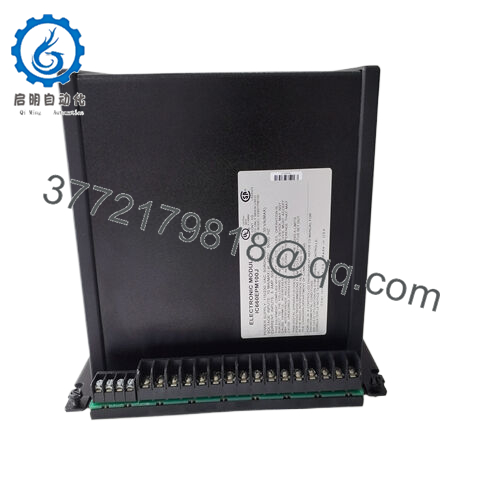
The GE IC660BBA103 Genius I/O thermocouple input block solves exactly this problem by placing six channels of isolated, cold-junction-compensated thermocouple acquisition directly in the harsh environment—up to 60 °C ambient without derating and with Class I Division 2 certification. Engineers choose the IC660BBA103 when they need rock-solid temperature measurement from Type R, S, T, J, K, E, or B thermocouples in locations where traditional remote I/O racks would cook and where every degree of accuracy directly affects product quality or burner efficiency. Instead of running 100 m of expensive compensation cable back to an air-conditioned control room, you mount the IC660BBA103 right on the furnace skirt or burner platform and communicate clean, linearized °C or °F data over a single twisted-pair Genius bus.
The block lives on the Genius I/O network as a standard 30-point device (six thermocouple inputs plus internal diagnostics) and communicates directly with Series 90-30, 90-70, PACSystems RX3i, or even third-party hosts that support Genius protocol. Each channel is individually isolated to 1500 V, breaking ground loops that plague non-isolated designs in steel mills and glass plants. Built-in cold-junction compensation and linearization happen inside the block, so the controller receives engineering units instead of raw mV—reducing PLC scan time and eliminating floating-point errors from doing the math yourself. On-board diagnostics report open thermocouples, over/under-range, and CJC faults instantly, letting operators distinguish between real process excursions and wiring problems without climbing the structure.

- IC660BBA103
| Specification | Details |
|---|---|
| Model Number | IC660BBA103 |
| Brand | GE (now Emerson) |
| Type | Thermocouple Input Block, 6 channels |
| Input Voltage | 93–132 V AC or 105–145 V DC (115 V nominal) |
| Operating Temp Range | 0 °C to 60 °C (full accuracy and load) |
| Mounting Style | Panel or DIN-rail with terminal base |
| Dimensions (W×H×D) | 224 × 90 × 224 mm (block only) |
| Weight | 1.8 kg (block) + 1.4 kg (terminal base) |
| Interface/Bus | Genius LAN (78.8 kbps dual twisted pair) |
| Compliance | CE, UL, CSA, Class I Div 2 Groups A–D |
| Supported Protocols | Genius I/O protocol |
| Typical Power Draw | 9 W (block) + 5 W (terminal base) |
Deploying the IC660BBA103 means your temperature loops stay accurate even when the block itself is bolted to a 55 °C burner platform. The combination of 1500 V channel-to-channel isolation and robust Genius bus noise immunity delivers measurement stability that remote-mounted smart transmitters often cannot match in electrically hostile areas. Maintenance teams love that an open thermocouple is reported in under 200 ms with a clear fault code—no more guessing whether the reading is real or a broken wire. Because the block is fully hot-swappable on the Genius bus, you can replace it during a short zone cooldown without taking the entire network offline. Over a decade or more of continuous operation in glass forehearths and heat-treat furnaces, the IC660BBA103 routinely outlasts the thermocouples it monitors.
The IC660BBA103 is a staple in primary metals (reheat furnaces, galvanizing lines), glass manufacturing (lehrs and forehearths), ceramics kilns, and any process requiring precise high-temperature control in harsh conditions. In aluminum remelt plants, multiple blocks monitor slab preheat zones while surviving the radiant heat and magnetic fields from induction coils. Glass container plants use them directly on tank channels where ambient temperatures regularly exceed 50 °C and cable runs to the control room would exceed 200 m—saving tens of thousands in compensation cable alone. Wherever you need critical system uptime and cannot afford temperature measurement drift, the IC660BBA103 has been the go-to block for more than two decades.
IC660BBA023 – 6-channel RTD input version for lower-temperature precision applications
IC660BBA023 – Same but 24 V DC powered version for battery-backed systems
IC660BBA106 – 6-channel current-input analog block often used alongside for pressure/flow
IC660BBA026 – 4–20 mA output block for valve positioning in the same rack
IC660BBD101 – Discrete 115 V AC I/O block for burner safety interlocks
IC660BBD120 – High-density 24 V DC discrete block for auxiliary limits
IC660BRD020 – Genius redundant bus controller for critical networks
Before powering up the IC660BBA103, verify that your Genius bus terminators are correctly set (75 Ω at each end) and that the block address matches the configuration in the PLC hardware tree—most sites use Hand-Held Monitor or VersaPro to set it once and forget it. Use only the matching IC660TBA103 terminal base; mixing with older bases can cause intermittent ground faults. Thermocouple wiring should enter through the bottom knockouts to keep condensation away from electronics. Once a year, cycle power to the block and confirm cold-junction calibration using a Type K ice-point reference—most plants find drift stays under ±0.5 °C for the life of the unit.