 WhatsApp: +86 16626708626
 Email:
  Phone: +86 16626708626
Description
In the precision-driven world of industrial automation, where temperature variations can dictate everything from reaction yields to equipment longevity, process control specialists often contend with the inaccuracies of raw sensor readings—susceptible to ambient influences, lead resistance, or linearization gaps—that might otherwise spawn off-spec products, energy waste, or safety thresholds breached by the slimmest margin. These vulnerabilities sharpen in continuous processing environments like distillation columns or HVAC chillers, where RTD or thermocouple inputs must convert reliably to standardized signals amid thermal gradients and EMI noise, lest minor deviations cascade into recalibrations that halt lines for hours and inflate validation costs. The ABB TR104 counters these realities as a rail-mounted temperature transmitter, a compact transducer that linearizes and scales sensor data into a crisp 4-20 mA loop output, fortifying signal reliability without the bulk of head-mounted alternatives or the setup hassles of multi-channel racks. Envision a boiler feedwater loop: unconditioned Pt100 signals could mask a 2°C offset from cable losses, risking scale buildup or efficiency dips, but the ABB TR104 applies NIST-compliant curves, galvanic isolation, and user-spannable ranges to deliver tamper-proof telemetry that integrates directly into DCS or PLC loops for stable PID tuning. It’s a mainstay in modular I/O schemes, from retrofitting legacy panels to expanding S800 or 800xA nodes in humid process areas, where high reliability underpins compliance with NAMUR NE43 standards and eases the engineering lift of dual calibrations or sensor swaps. This transmitter aligns with industrial automation’s quest for leaner field interfaces, embedding diagnostics like burnout detection to preempt outages while curbing the wiring sprawl of unamplified probes. Far from a basic conditioner, the ABB TR104 forges a trustworthy thermal narrative, empowering teams to hone control strategies on faithful data, in deployments where temperature fidelity bridges routine monitoring and resilient operations.
The ABB TR104 anchors in the sensor-to-control conduit of ABB’s process instrumentation lineup, such as the TTH200 or Eco series, functioning as a single-loop converter that accepts universal inputs—Pt100, thermocouples Types J/K/T/N, or 4-20 mA—then conditions and transmits a proportional current signal over a 2-wire loop powered by 11-42 V DC. It snaps onto 35 mm DIN rails in marshalling cabinets, interfacing via screw terminals for sensor leads and loop output, where it employs a microcontroller for cold-junction compensation and linearization per ITS-90 tables, minimizing errors to under 0.1% span. In a typical S800 integration, it feeds an AI810 analog input module over the ModuleBus, enabling HART optional overlays for remote configuration via handheld or 800xA asset management, with fault modes like upscale/downscale on sensor break to flag issues without loop disruption. This supports redundancy through paralleled units in dual-sensor loops, where a standby ABB TR104 mirrors primaries for bumpless handoff in SIL 2-rated chains. Diagnostics include LED status for health checks and self-test routines queryable over HART, while its galvanic isolation (up to 1.5 kV) shields against ground potentials in noisy bays. Positioned at the field edge of the I/O stack, it decouples raw thermal variances—like junction shifts—from backplane logic, ensuring clean ascent for trend analysis or alarm matrices in rack ecosystems. For hybrid setups, the ABB TR104 accommodates software tweaks via ABB’s FieldCare tool, rooting expansions from isolated transmitters to networked thermal webs where loop integrity underpins unyielding process control.

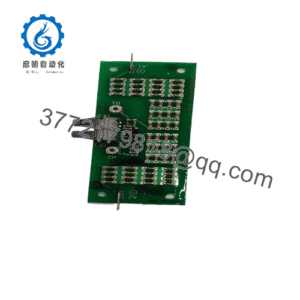
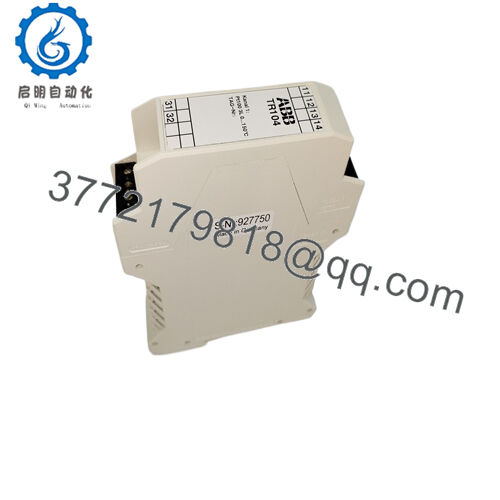
- TR104
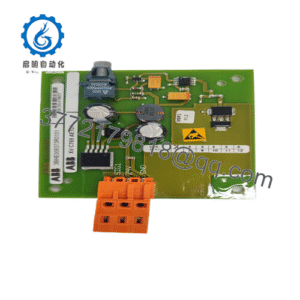
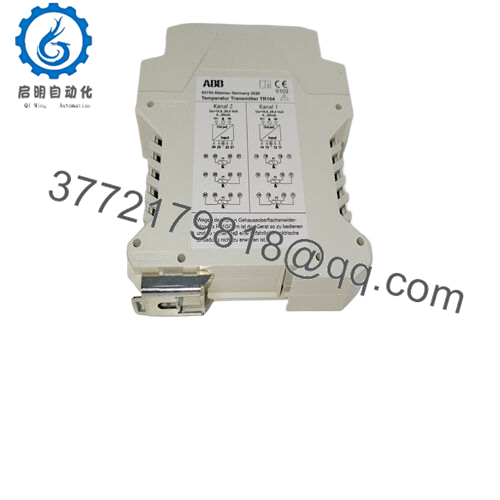
- TR104
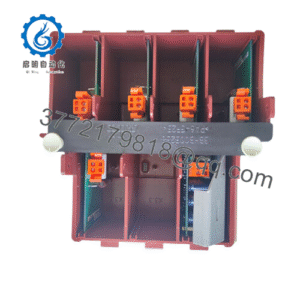
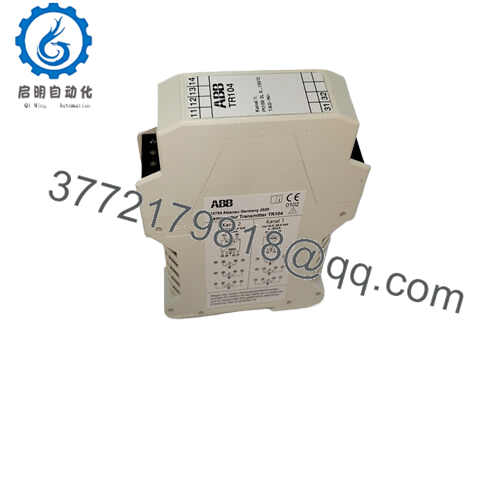
- TR104
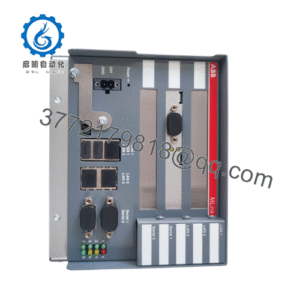
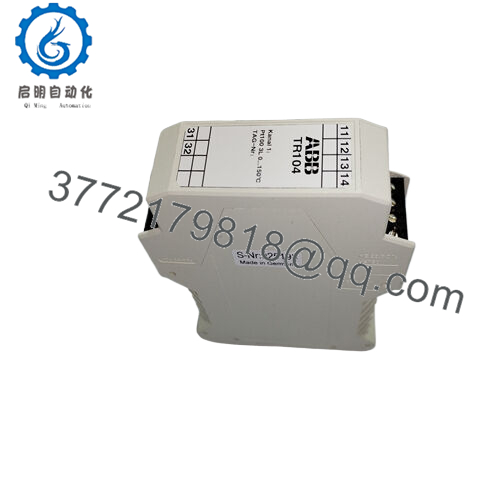
- TR104
| Specification | Details |
|---|---|
| Model Number | TR104 |
| Brand | ABB |
| Type | Temperature Transmitter |
| Input Voltage | 11-42 V DC (loop-powered) |
| Operating Temp Range | -40°C to +85°C |
| Mounting Style | DIN Rail (35 mm) |
| Dimensions | 22.5 mm x 75 mm x 112 mm |
| Weight | 0.1 kg |
| Interface/Bus | 4-20 mA / HART (optional) |
| Compliance | CE, RoHS, NAMUR NE43 |
| Supported Protocols | HART 5/6/7 (optional) |
| Typical Power Draw | 20 mA @ 24 V DC |
Opting for the ABB TR104 equips your thermal sensing with a transducer tailored for unwavering fidelity, where its universal input handling quells the inconsistencies that might skew loop accuracies, yielding tighter setpoints and fewer process excursions that preserve yields in flux-prone reactors without the drag of frequent bench calibrations. In the grind of continuous runs, this reliability translates to baselines that hold through seasonal swings, letting you layer in optimizations like feedforward compensations on steady telemetry rather than chasing offsets from unconditioned probes.
The device’s rail-slender profile and loop-powered economy further ease assimilation into S800 cabinets, as drop-in DIN compatibility trims panel proofs and spares the rework of bulky enclosures, funneling efforts toward core tuning over terminal tallies. Maintenance cadences benefit similarly, with HART-enabled self-diagnostics that cue sensor breaks upfront—via loop pulses—narrowing scopes to targeted verifies and elongating spans betwixt full re-spans, which compounds to a leaner spares ledger and amplified instrument tenure.
Fundamentally, the ABB TR104 nurtures a precise pulse in sensor-sparse industrial automation, where such converters not only gird data guile but also germinate scopes for fused flux, like wireless HART on flux feeds, all unburdened by the tangle of tailored term blocks or the snares of unquenched quivers.
In chemical reactors, the ABB TR104 linearizes Pt100 feeds from jacket sensors into 4-20 mA for S800 AI modules, where it upholds high reliability amid vapor veils and agitation throbs, anchoring process control environments that demand sub-°C precision for exothermic curbs in batch process control webs.
HVAC district cooling loops harness the ABB TR104 for chilled water thermocouple ties, ensuring critical system uptime against frost fluxes and pump pulses, with loop clout locking COP metrics tight and nipping inefficiencies in zoned process control scaffolds.
Food pasteurization lines embed the ABB TR104 to scale RTDs on hold tubes, backing fast data cycles under steam surges and sanitary streams, where its transmitter tenacity holds kill steps seamless and balks under-heats in compliant process control frames.
TR03 – Head-mounted variant for direct sensor immersion in harsh zones.
TR204 – Dual-channel model for redundant thermal loops in SIL apps.
TTH200 – HART-enhanced successor with Foundation Fieldbus options.
TTH300 – Advanced series with diagnostics for predictive maintenance.
TR04-Ex – Explosion-proof edition for Zone 1 hazardous areas.
TET10 – RTD sensor companion for Pt100 inputs to TR104.
TMP11 – Thermocouple probe pair for Type K/J extensions.
3BSE004878R1 – Legacy interface for older DCS thermal integrations.
Before deploying the ABB TR104, map your sensor type—Pt100 3-wire or TC Type K—to the rotary DIP switches for initial range, ensuring loop resistance under 600 Ω to avoid voltage drops that cap at 20 mA output, and verify DIN rail flatness to prevent vibration-induced shorts in mobile skids. In humid bays, confirm enclosure IP20 suffices or add shrouds for condensation, while a pre-install loop test with a decade box confirms linearity within 0.05% across the span, syncing with FieldCare for HART-enabled baselines to nix post-fit tweaks.
Sustaining it stays pragmatic: monitor output stability quarterly via a milliamp meter against known temps, spotting drifts from lead corrosion early, and reseat terminals after thermal cycles to maintain <0.1 Ω contact. Annually, during shutdowns, execute a full-range calibration with a dry-block calibrator per ISO 17025 traces, isolating the loop without DCS halts, and wipe housings with ESD-safe cloths to curb dust films in gritty sites. These steps frame the ABB TR104 as a low-profile ally, surfacing quirks before they skew spans and upholding your thermal thread with measured thrift.