 WhatsApp: +86 16626708626
 Email:
  Phone: +86 16626708626
Description
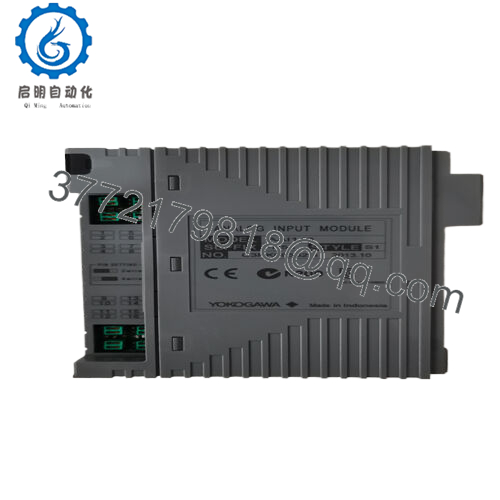
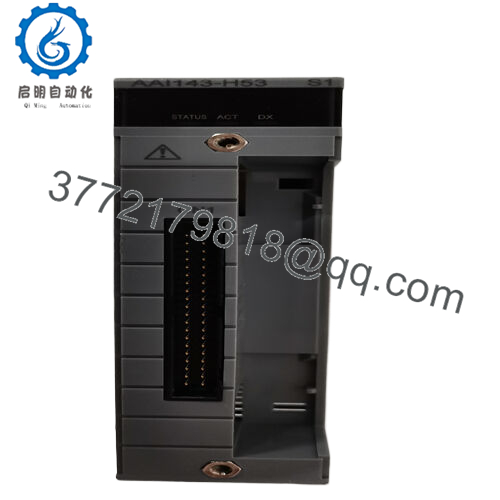
Product Model: AAI143
Product Brand: Yokogawa
Product Series: AAI Analog Input Module Series
Key Features:
- 16 isolated input channels for 4–20 mA signals
- High accuracy (±16 µA) and 10 ms update rate
- Supports HART communication and redundant operation
- Rugged, field-proven design for process automation environments

- AAI143
Applications & Industry Context
When you walk through a modern process plant — whether it’s an oil refinery, a power station, or a pharmaceutical blending facility — you’ll find countless sensors quietly feeding data into a distributed control system. Each transmitter reports a 4–20 mA signal that represents temperature, flow, or pressure, and the job of translating those signals into something the control system can understand falls to modules like the AAI143 Yokogawa.
In real installations, the AAI143 Yokogawa is the link between field devices and the DCS (CENTUM CS 3000, VP, or similar). It handles the dirty, noisy, electrical side of industrial life so the control engineers can focus on logic and optimization instead of ground loops or voltage offsets.
The module’s isolated channels are especially valuable in large plants where transmitters may sit hundreds of meters from the control room, connected by long cable runs through harsh conditions. Each channel isolates the field loop from the system bus, preventing interference and protecting equipment from surges and earth faults.
Typical industries using AAI143 Yokogawa include refining, petrochemical processing, pulp & paper, food manufacturing, water and wastewater treatment, and power generation. In these plants, the module forms part of an I/O subsystem mounted in a Yokogawa rack, paired with analog output modules (AAI543 series), digital I/O, and controller CPUs.
Beyond mainstream process industries, system integrators also use AAI143 Yokogawa modules for lab automation, test stands, and skid-mounted systems requiring compact, multi-channel signal acquisition with industrial reliability.
Technical Features & Benefits
Engineers who specify the AAI143 Yokogawa Analog Input Module do so for a reason — it delivers performance and stability that directly translate into plant reliability. Let’s unpack its strengths and how they help in practice.
Isolated Signal Design
Each of the 16 input channels is individually isolated from the system bus, which prevents cross-channel interference and protects the controller from field faults. This means a fault in one sensor loop won’t affect the rest of the plant.
Accuracy and Update Speed
The AAI143 offers a sampling period of about 10 milliseconds per channel and an accuracy of ±16 microamps on a 4–20 mA range. That’s tight enough for precision temperature and pressure control loops and fast enough for real-time interlocks or advanced PID algorithms.
HART Capability
Many variants of the AAI143 family support HART digital communication, allowing transmitters to send secondary variables, diagnostics, and status data over the same pair of wires. This lets maintenance teams access device health without touching the process loop.
Redundant Operation
For critical applications, Yokogawa designed the module for dual-redundant deployment. Two AAI143 units can be configured in parallel; if one fails or needs replacement, the other seamlessly takes over. In continuous process industries, that feature saves hours of downtime and potential product loss.
Temperature and Drift Control
Temperature effects are minimized through internal compensation circuits. Even when ambient conditions swing by 10 °C, the measured error stays around ±16 µA. It’s a small number with a big impact on long-term process stability.
Mechanical and Electrical Reliability
Like all Yokogawa I/O modules, the AAI143 Yokogawa is built for decades of service. The conformal coated circuit boards withstand humidity and chemical vapors; locking connectors ensure contact integrity in high-vibration areas.
System Integration
The module slots into Yokogawa’s standard I/O racks and interfaces seamlessly with control processors via the V-net or field control unit backplane. Its firmware supports configuration through engineering tools such as CENTUM Control Builder, making it easy to assign tags and ranges or calibrate channels in software.
Together, these features make the AAI143 Yokogawa not just a signal collector but a reliability anchor for entire control loops.
Technical Specifications Table
| Specification | Description |
|---|---|
| Model Number | AAI143 |
| Brand | Yokogawa |
| Function | Analog Input Module (16 channels) |
| Input Signal | 4–20 mA DC (others configurable) |
| Input Resistance | Approx. 270 Ω at 20 mA |
| Accuracy | ±16 µA (25 °C) |
| Update Time | 10 ms per channel |
| Isolation Voltage | 1,500 VAC for 1 minute (between input and system) |
| Operating Temperature | 0 – 55 °C |
| Power Supply | 5 V DC / 24 V DC from backplane |
| Module Weight | ≈ 0.3 kg |
| Redundancy Support | Yes (dual module configuration) |
| HART Support | Available on specific variants |
Installation & Maintenance Insights
Even experienced engineers appreciate that installation details can make or break an I/O system. Here’s what decades in the field have taught about the AAI143 Yokogawa family.
Physical Mounting and Cabling
Mount the module vertically in a clean, dry rack to maintain airflow and thermal stability. Keep power and signal cables separated to minimize EMI. For long runs, use shielded twisted pairs and terminate the shield at one end only — the system end — to avoid ground loops.
Channel Configuration
Each channel can be set for 2-wire or 4-wire transmitters. Follow the manual’s pin-setting instructions and verify with a multimeter before power-up. Incorrect loop polarity is a common startup pitfall.
Commissioning and Calibration
Before handover, inject known signals (4 mA, 12 mA, 20 mA) and compare module readings. Small offsets can be trimmed in the engineering software. Save parameter sets to your project backup so you can restore them if a module is replaced later.
Maintenance Routine
Visual inspection every six months is usually enough. Look for loose screws, dust accumulation, and signs of moisture. Since the module has no moving parts, failures are rare; most issues trace back to field wiring or incorrect configuration.
Module Replacement Tips
When hot-swapping in a redundant system, confirm that the standby module is healthy before removing the active one. The AAI143 supports automatic parameter synchronization in many DCS versions, but it’s good practice to record firmware and revision numbers before replacement.
A little discipline here means years of trouble-free operation later — and that’s why seasoned technicians respect the AAI143 Yokogawa as a “fit-and-forget” module.
Product Role & System Fit
At its core, the AAI143 Yokogawa is a translator between analog reality and digital control. It collects measurements from transmitters, isolates and converts them into digital values, and hands them to the controller CPU.
The module is part of Yokogawa’s AAI (Analog Input) family, designed for use with CENTUM series distributed control systems and STARDOM hybrid controllers. Within the rack, it interfaces with the Field Control Unit (FCU) through a backplane connector and communicates using standardized protocols.
Compatibility with older and newer systems makes AAI143 Yokogawa a favorite for retrofits. It drops into existing frames without rewiring and works with legacy function blocks and I/O databases. This continuity saves thousands of engineering hours during migration projects.
Integration is straightforward because the module’s configuration parameters (map range, offset, tag, scaling) are handled in software. If the system detects a fault — say, open loop or out-of-range signal — the controller flags an alarm immediately, helping operators pinpoint the issue.
So while the AAI143 Yokogawa may sit quietly in a cabinet, it plays a central role in the plant’s ability to see what’s happening and respond before small disturbances become production losses.
Related Models
- AAI143-S00 – Standard type, no explosion protection.
- AAI143-S50 – Standard type with enhanced accuracy and dual-redundant support.
- AAI143-E50 – Intrinsic-safety variant for hazardous areas.
- AAI143-H50 – HART-enabled model supporting digital device communication.
- AAI543 – Analog Output Module complementing the AAI143 inputs.
- AAD143 – Analog Input for voltage signals instead of current.
- ADV151 – Analog Input module for higher-density applications in newer racks.
Each shares Yokogawa’s modular architecture but differs in signal type, certification, and system generation support.